
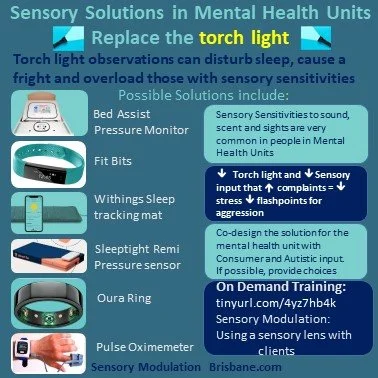
Using alternatives to torch light monitoring in Mental Health Units
This blog will outline some of the challenges involved in using torch light to observe clients in mental health units at night and also provide some alternative options.
What are observations in mental health units at night?
Part of routine mental health care on mental health units is regular observations of people while they are sleeping/lying in bed. These routine observations are undertaken due to their perceived benefit in ensuring safety and wellbeing and to reduce the risk of suicide or severe harm. Nursing staff may need to complete observations up to 4 times per hour overnight and torch light is frequently used.
Veale et al (2019) researched the lived experience of these observations and found that these observations interrupted sleep through the torch light, sounds of staff opening and closing bedroom doors and staff talking to each other. People also reported that they found having somebody enter the room in the middle of the night intimidating and unsettling. For many people, this interruption can then make it difficult to return to sleep.




Multisensory top down templates and multi sensory integration
2023 has had a number of articles released on multi sensory integration with some important findings including:
· Multisensory functional brain networks
· Multisensory templates as a top down process
· Multisensory processing occurring at earliest stages of information processing.
Some of the important points from these articles have been included but they are worth reading in their entirety if you are interested in this area.

Evidence base for sensory modulation in the reduction of restrictive practice for NDIS participants
Evidence base for Sensory Modulation in the reduction of restrictive practices for NDIS participants
We have recorded a presentation and this is available on youtube.
The reference list for this presentation is available here:

Predictive Processing and Body image disturbance in Anorexia Nervosa
When a person with Anorexia Nervosa looks in the mirror, they often report seeing someone who is very overweight rather than the thin body that they actually have.
In the classic detector model of sensory processing, it can be hard to understand how the person can see something that is not reality.
Predictive processing* provides another explanation. that the person is seeing the brains prior model or prediction that they will see, and due to the stress of the condition , they are ‘stuck’ on the predicted model unable to see the reality. A persons predictions are built up from prior experiences and also information from interoception ie feeling fat.
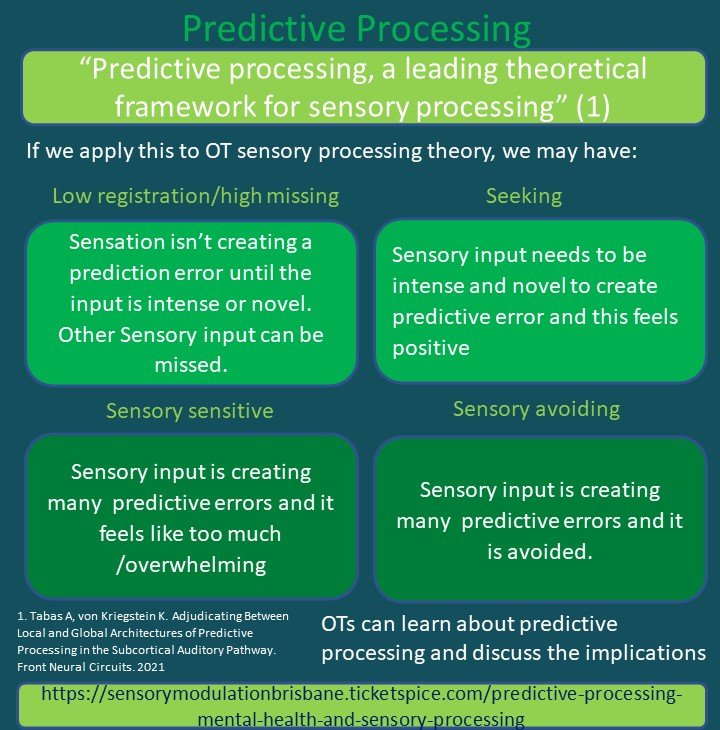
Predictive processing: a leading theoretical framework for sensory processing
Predictive Processing is a computational theory of brain functioning where the brain continuously works to minimise error between existing model-based predictions and incoming information (May et al 2021). The theory asserts that the brain generates prior models or predictions of sensory input at multiple levels, generating expectations or inferences regarding future input. This function serves to minimise uncertainties and maximise efficiencies (Wilkinson et al, 2017). Predictive processing as a theory also helps to explain the large number of descending connections in the brain (Walsh et al 2020). In the instances where unpredicted or unexpected sensory input is detected (referred to as a prediction error) this information may pass through these multiple layer and then can update the prior model.
Predictive Processing has been described as “A leading theoretical framework for Sensory Processing” (Tabas et al 2021) and has a lot of ‘explanatory power’ for mental health and sensory processing clinical areas.
When we consider that the brain is largely predicting rather than reacting to sensory input, it may have clinical implications for OTs.

Sniff research in Autism
Scent research in Autism
An older article from 2015 on scent and sniffing pleasant and unpleasant odors, noted that Autistics sniffed at pleasant and unpleasant odors with the same intensity whereas neurotypicals sniffed more intensely with pleasant odors and less intensely with unpleasant odors.
We wonder if the more intense sniff is increasing the intensity of the scent and thus contributing to increased sensory overwhelm to scent?
We would love to see some research into whether this could be developed into an easy intervention. We searched articles this week and could not find interventions but please let us know if there are some.
We would propose an intervention where Autistic children could learn to visually identify potentially unpleasant scents (this would need to be individually tailored) and also learn to control the intensity of their sniff to decrease the overwhelm. This could focus on scents that are more commonplace in everyday environments (schools, shops) and where the scent is impacting on occupations.
It has been difficult to research the olfactory (scent) sense in Autism, partly due to the difficulties with accuracy of measurement. A new precise and easy to use system has been developed – the odor pulse ejection system. It is described in this article:
https://www.frontiersin.org/articles/10.3389/fnhum.2020.523456/full
This system was designed to more accurately measure olfactory processing including odor detection, identification and evaluation. Findings of the study using the odor pulse ejection system suggest differences in aspects of olfactory processing for autistics, including olfactory working memory and/or attention.
Xu, M., Minagawa, Y., Kumazaki, H., Okada, K., & Naoi, N. (2020). Prefrontal Responses to Odors in Individuals With Autism Spectrum Disorders: Functional NIRS Measurement Combined With a Fragrance Pulse Ejection System. Frontiers in Human Neuroscience, 14. https://doi.org/10.3389/fnhum.2020.523456

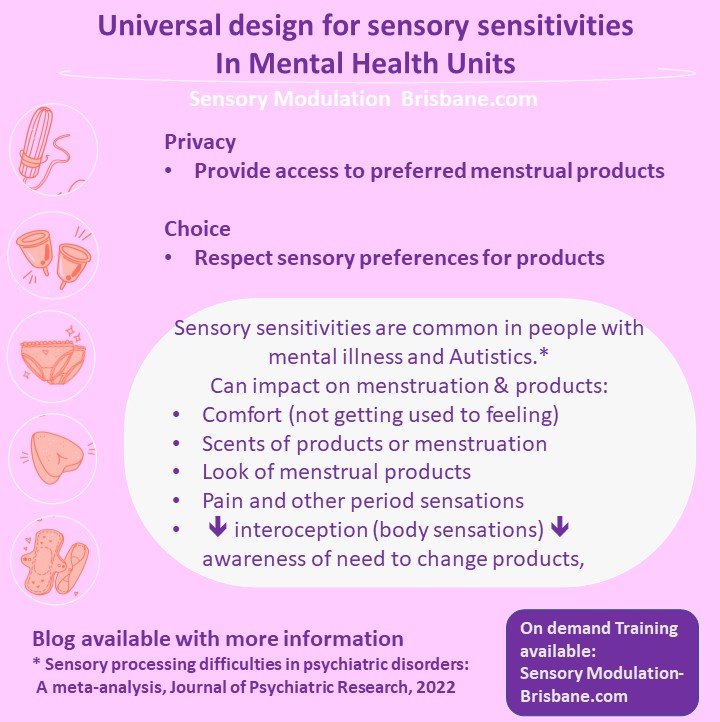
Providing choice of menstrual products in Mental Health Unit Design
Sensory sensitivities are common in people with mental illness and Autistics and (1)
can impact on periods & menstrual products. This can include:
· touch
· visual input
· scent
· coordination and fine motor skills
· trauma
· pain and Interoception
· familiarity and uncertainty
Touch
When choosing menstrual products, there can be a variety of different preferences for touch sensations in menstrual products This includes the feeling of a tampon and cup (sometimes lubricant changes the dry tampon feeling) or the feeling of a bulky pad in underwear, or the feeling of the pad against the skin. If new to menstrual cycles it is useful to explore what option is the most comfortable. If the person has a preference then it is important to enable access to this preference. . When someone is sensitive to touch they can be unable to get used to (habituate) a sensation and this can be very irritating, distressing or overwhelming.

Sensory Assault
This blog is a commentary on a recent article by Beth Ohannesson Sarah Schoen, Vanessa Mitchell B Parent perspectives on children with sensory over-responsivity. The article describes a study in which parents of children with sensory over responsivity and sensory meltdowns/ sensory over responsivity episodes described their childrens description of the episodes and the strategies that they used to manage them.

Therapy rooms and waiting rooms: designing for sensory needs
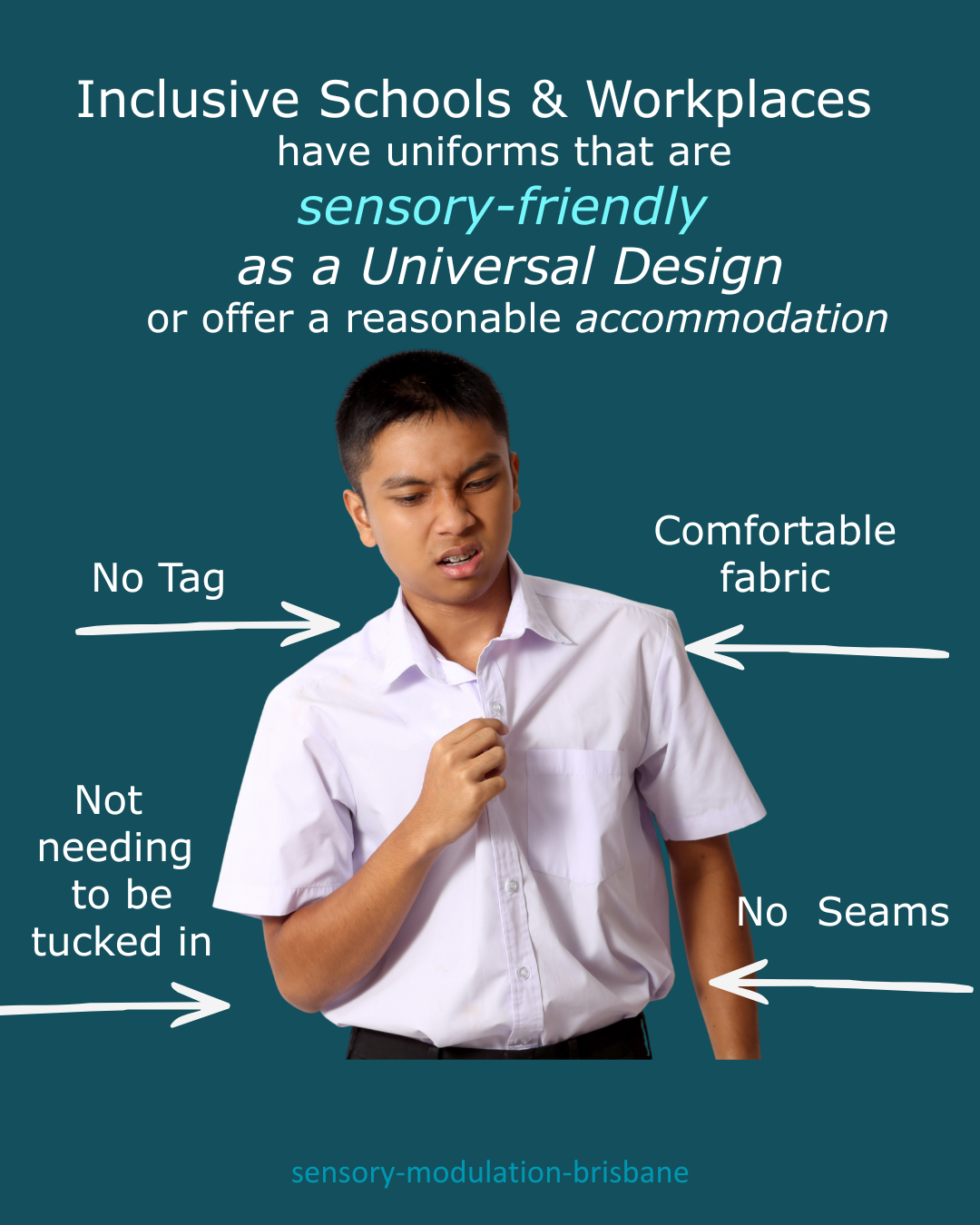
At Sensory Modulation Brisbane, we have been advocating for Universal Design in Mental Health Units for Sensory Sensitivities and we would recommend that this is expanded to therapy rooms, waiting rooms and all health care spaces.
Many people who attend Therapy practices have sensory processing patterns that are more sensitive, more avoiding, or more seeking or more missing of sensations than others and this can vary between different senses. This includes:
· Autistics have sensory processing differences recognised as a diagnostic criteria. (DSM5)
· People with PTSD often have reactivity and hypervigilance to certain sensations
· People with schizophrenia often have auditory processing and visual perception challenges.
· ADHDers frequently have sensory processing differences (Schulze 2020)
· A high percentage of people with mental illness have interoceptive difficulties