
Sex and Intimacy

Blog – Sensory Modulation Interventions to Support Sexual Intimacy
Sexual intimacy, which includes sex, sexual activities and other intimate activities, for many is an important and meaningful occupational role. Participation in sexual intimacy can be influenced and impacted by a range of factors. This blog suggests that using a sensory lens to explore some of these factors in more detail can be beneficial. Furthermore, sensory solutions can go a long way to help support a person’s feelings of safety, enjoyment and engagement in sexual intimacy.
To better understand sexual intimacy with regard to factors that impact sexual response and arousal, it is helpful to understand the Dual-control model of sexual response. This model was developed by Bancroft and Janssen (2007) and proposes –
Desire is not a state that is either ‘present’ or ‘absent’
Sexual response results from excitation (the accelerator) and inhibition (the brake) acting together
The intensity of a person’s sexual response is dependent on how strongly these systems are activated at any given time
While the excitation system seems to receive much of the attention with regard to sexual response and arousal, it is just as important to understand and address the inhibition system. The inhibition system plays a protective role and as such responds to factors that can result in reducing or blocking sexual arousal. This can include stress, fatigue, pain, feelings of fear, disgust or shame, past trauma, or performance worries.
If inhibition levels are high, it can be helpful to consider addressing the inhibitory factors (reducing pressure on the brake) as a means to enhance sexual response, rather than purely focusing on increasing excitatory factors/stimulation (pumping the accelerator).
Sensory modulation interventions are an effective approach to help address both excitatory and inhibitory factors. This may include –
Decreasing, limiting or eliminating certain unwanted or problematic sensory input
Increasing certain sensory input
Introducing new sensory input
Sensory Modulation Brisbane has just released on demand training ‘Sex, Intimacy and Sensory Modulation’.
There are 2 tailored on demand training packages to choose from –
1. A training package designed for anyone who would like to gain a better understanding of and tailored strategies to support their engagement in sexual intimacy.
2. A training package designed for clinicians, support workers and those supporting individuals who would gain benefit from a better understanding of and tailored strategies to support their engagement in sexual intimacy.
While beneficial for everyone, the training content may be especially helpful for those with sensory sensitivities, sensory differences and distinct preferences, neurodivergence, experience of trauma and physical issues including fatigue and pain. It will increase confidence in supporting the application of a range of tailored sensory informed strategies which go beyond traditional calming and alerting models.
The on demand training highlights the valuable role of sensory modulation in supporting a person’s participation in sexual intimacy and incorporates the following content -
Explanation of sensory modulation as an intervention
Dual control model of sexual response, outlining the role of excitation and inhibition mechanisms and factors that impact on these.
Application of practical sensory modulation strategies to support a person’s sexual intimacy, through:
* Building sensory awareness with regard to sexual intimacy
* Using the DIN model - decreasing, increasing and adding (new) sensory input
* Communication strategies to promote safety, self advocacy and comfort
Slides and handouts are provided to assist with learning and application of content.
For more information on the on demand training:
Sensory Modulation for Sex and Intimacy - clinician version
Sensory Modulation for Sex and Intimacy - self directed version
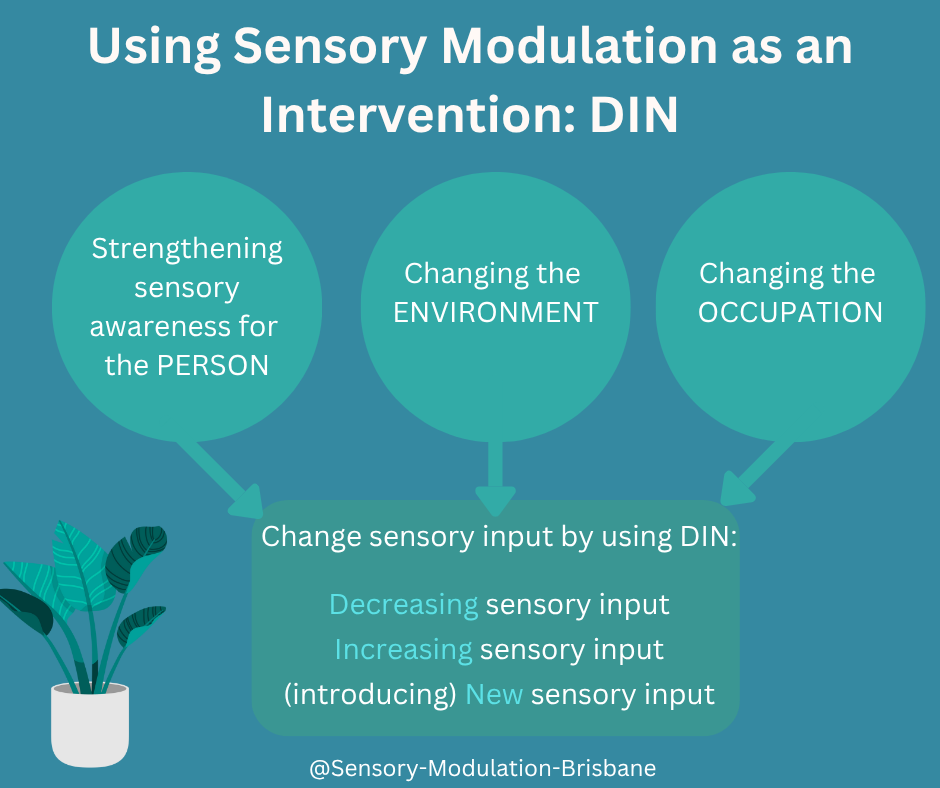
using Sensory Modulation as an Intervention: DIN
The model proposes that sensory modulation works by addressing the following three constructs:
1. Strengthening sensory awareness for the Person
2. Changing the Environment
3. Changing the Occupation
For each of these three areas, sensory input can be changed by using the acronym DIN -
· Decreasing the sensory input
· Increasing the sensory input
· (introducing) New sensory input

Sensory modulation as an intervention is ‘changing how you feel through using your senses’ (O’Sullivan & Fitzgibbon, 2018). In adjusting specific sensory input, a better match is achieved between the person (and their unique sensory needs), the sensory demands of the environment and their occupations. The person is supported to draw on their strengths, available resources and functional capabilities to enhance participation in meaningful occupations and activities of choice. By honouring an individual’s sensory experiences, and not aiming to mask, or tolerate unique neurology, sensory modulation as an intervention is person-centred, neurodiverse affirming and trauma informed.
Below is a description of the model (shown in the diagram above) using sensory modulation as an intervention. It draws from the PEO Model of occupational performance (Law et al, 1996). The model proposes that sensory modulation works by addressing the following three constructs:
1. Strengthening sensory awareness for the Person
Strengthening awareness of a person’s sensory needs facilitates the development of knowledge, skills and tools regarding unique sensory preferences, capacities, and the environments and activities that best promote functioning. This aligns with the concept of sensory health (Bailliard et al, 2022) and supports the development of agency and expertise.
2. Changing the Environment
This involves:
· The identification and exploration of alternative and beneficial environmental sensory input; or
· Consideration of ways to change sensory aspects of the environment to create a better person-environment fit; or
· Transitioning to a different or preferred environment if more appropriate.
Sensory aspect/s of the environment that do not meet the person’s needs or negatively impact social, emotional and occupational functioning can also be identified and addressed.
3. Changing the Occupation
This involves:
· Exploration of alternative and beneficial sensory input; or
· Consideration of options to adapt/modify aspects of the activity to create a better person-occupation fit; or
· Change the occupation.
Sensory aspect/s of the task not meeting the person’s sensory needs or negatively impacting engagement in preferred occupations and activities can also be identified and addressed.
For each of these three areas, sensory input can be changed by using the acronym DIN -
· Decreasing the sensory input
· Increasing the sensory input
· (introducing) New sensory input
D – Decreasing sensory input
For individuals exhibiting sensory sensitivities, sensory avoidance, trauma histories or neurodivergence, decreasing, avoiding or eliminating certain sensory input can promote safety, autonomy, and participation (Dana, 2018, 2011; Porges, 2011). Reducing sensory input that is unwanted can better align the environment and/or occupations with an individual’s sensory processing needs and occupational goals.
I – Increasing sensory input
Increasing sensory input (intensity, frequency, or predictability) could include moving the body to help with emotion regulation, touch input for grounding and listening to familiar music for calming. Auditory cues to match the demands of the occupation can assist with focus and task engagement. Overstimulation or dysregulation is avoided by ensuring strategies are SAIM (Safe, Appropriate, Individualised and Meaningful) and context relevant. Reducing unwanted or aversive sensory input prior to increasing select sensory input is recommended.
N – (introducing) New sensory input
The new sensory input introduced may be familiar to the person but not usually present in that particular activity or environment. It could be novel to that situation or unfamiliar to the person, such as an unfamiliar food or drink item. New or novel sensory input may be ones that are soothing, grounding or focusing for the person, or ones that help regulate the sensory experience, for example, introducing white noise or nature sounds to help compete with/dial down unwanted sound input or help manage the experience of silence/not enough sound.
Case scenarios to illustrate
Jing’s Sensory Overwhelm in Cooking
Jing experiences sensory overload from olfactory, auditory, and visual stimuli during meal preparation, triggering anxiety, overwhelm and fatigue. Environmental modifications such as using a lid on the saucepan, lowering stove heat, dimming lights, increasing ventilation, and wearing earplugs reduce sensory load, enabling sustained task engagement. Occupational adaptations include breaking the cooking process into smaller tasks completed at different times or delegating components to family members, which supports Jing’s regulation, autonomy, and participation (Edgelow & Cramm, 2020).
Isaac’s sensitivity to Visual Input
Isaac’s trauma history leads to panic and dissociation triggered by bright lighting and visual movement in public spaces. His OT identified strategies such as dimming or redirecting lights, covering fluorescent bulbs, using curtains, or selecting quieter locations to reduce visual stimulation. Occupational modifications include riding as a passenger during heavy traffic and slowing movement pace (e.g., when pushing a wheelchair). Additional self-regulation strategies include wearing a cap or sunglasses and narrowing his visual field. A referral for vision assessment may help address any underlying visual-perceptual contributors to discomfort.
References
Bailliard A, Dunn W, Brown C and Engel-Yeger B (2022) Editorial: Meaningful participation and sensory processing. Front. Psychol. 13:1045650. doi: 10.3389/fpsyg.2022.1045650
Dana, D. A. (2018). The polyvagal theory in therapy: Engaging the rhythm of regulation. W. W. Norton & Company.
Edgelow, M., & Cramm, H. (2020). Developing an Occupation-Centred Framework for Trauma Intervention. Occupational Therapy in Mental Health, 36(3), 270–290. https://doi.org/10.1080/0164212X.2020.1808148
Law M, Cooper B, Strong S, Stewart D, Rigby P, Letts L (1996). The person-environment-occupation model: a transactive approach to occupational performance. Canadian Journal of Occupational Therapy. 63:9–23.
O’Sullivan, J., & Fitzgibbon, C. (2018). Sensory modulation: Changing how you feel through using your senses. Resource Manual. Julie O’Sullivan and Carolyn Fitzgibbon. Brisbanehttp://sensory-modulation-brisbane.com/sensory-modulation-resource-manual.
Porges, S. W. (2011). The Polyvagal Theory: Neurophysiological Foundations of Emotions, Attachment, Communication, and Self-regulation. W. W. Norton.