Using alternatives to torch light monitoring in Mental Health Unit Design
This blog will outline some of the challenges involved in using torch light to observe clients in mental health units at night and also provide some alternative options. Part of routine mental health care on mental health units is regular observations of people while they are sleeping/lying in bed. These routine observations are undertaken due to their perceived benefit in ensuring safety and wellbeing and to reduce the risk of suicide or severe harm. Nursing staff may need to complete observations up to 4 times per hour overnight and torch light is frequently used.

This blog will outline some of the challenges involved in using torch light to observe clients in mental health units at night and also provide some alternative options. Part of routine mental health care on mental health units is regular observations of people while they are sleeping/lying in bed. These routine observations are undertaken due to their perceived benefit in ensuring safety and wellbeing and to reduce the risk of suicide or severe harm. Nursing staff may need to complete observations up to 4 times per hour overnight and torch light is frequently used.
Veale et al (2019) researched the lived experience of these observations and found that these observations interrupted sleep through the torch light, sounds of staff opening and closing bedroom doors and staff talking to each other. People also reported that they found having somebody enter the room in the middle of the night intimidating and unsettling. For many people, this interruption can then make it difficult to return to sleep.
Improving sleep quality on mental health units is important to improve mental health and reduce suicide risk and decrease use of hypnotic medications. (Gardiner 2022) Improving sleep quality has been found to reduce aggressive incidents for psychiatric inpatients residing in secure facilities such as forensic psychiatric hospitals. (Van Veen et al 2020)
Alternatives to torch light that have been discussed have included remote monitoring systems, location trackers and video trackers. The majority of people found the remote monitoring systems acceptable (Veale et al 2019) but the location tracking and video monitoring have been identified as unsuitable due to privacy concerns. (Guardian, 2022)
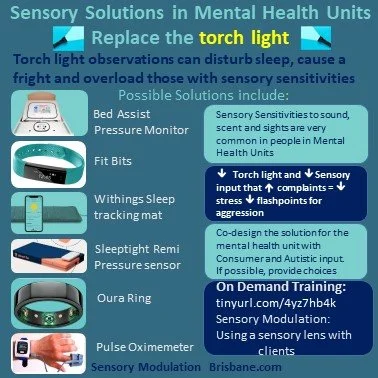
Sensory Modulation Brisbane has identified the following remote monitoring systems as possible options to replace torch light observations:
At Sensory Modulation Brisbane, we are calling for Universal Design in Mental Health Units for Sensory Sensitivities and this would include replacing torch light observations. The rationale is that so many mental health diagnoses have people with sensory sensitivities. This would also assist Autistics who were on mental health units. People with other sensory processing preferences could also be catered for through adding in personally preferred input from a base of catering for sensory sensitivities.
Sensory Modulation Brisbane also has recorded an online course which includes information on the importance of changing the environment in healthcare settings: tinyurl.com/4yz7hb4k
https://sensorymodulationbrisbane.ticketspice.com/sensory-modulation-using-a-sensory-
lens-with-clients
#Universaldesigninmentalhealthunitssensorysensitivities #sensory #mental health #autistic #mentalhealth_community #schizophrenia #sensoryprocessingawareness #sensoryprocessingsensitivity #psychiatric #occupationaltherapy
More Information:
“This paper argues that intermittent nursing observations of in-patients at night do not reduce the risk of suicide or severe self-harm. Suicides between 23.00 h and 07.00 h are rare, and these overwhelmingly occur under intermittent observations. Such observation is purely a defensive intervention to document that a patient is safe at a particular time, as there is no engagement. For the large majority of in-patients, it has the unintended consequence of causing sleep deprivation. The intervention may cause harm to in-patients by making their disorder worse and increase their risk during the day. If patients are judged to be at immediate risk, then they should be placed on constant observation. If they are not, then optimising sleep is important for treating a psychiatric disorder and they should be placed on general observations.”
Veale D. Against the stream: intermittent nurse observations of in-patients at night serve no purpose and cause sleep deprivation. BJPsych Bull. 2019 Aug;43(4):174-176. doi: 10.1192/bjb.2018.116. Epub 2019 Feb 11. PMID: 30739621; PMCID: PMC6642991
“For psychiatric inpatients residing in secure facilities such as forensic psychiatric hospitals, worse sleep quality and higher insomnia scores significantly relate to aggression, hostility and violent incidents (Kamphuis et al., 2014). Thus, targeting inpatient sleep quality can help to reduce aggressive incidents in these populations, which is paramount to continued successful psychiatric treatment (Van Veen et al., 2020).”
Maaike M. Van Veen, Julie Karsten, Robbert-Jan Verkes & Marike Lancel (2020) Sleep quality is associated with aggression in forensic psychiatric patients, independent of general psychopathology, The Journal of Forensic Psychiatry & Psychology, 31:5, 699-713, DOI: 10.1080/14789949.2020.1785526
“A systematic search of the literature on the environment and nursing observations at night revealed few studies conducted on a psychiatric ward. A meta-analysis identifies the problems of sleep deprivation through noise on medical wards (DuBose & Hadi, 2016). There are also studies identifying that the large majority of psychiatric inpatients experience insomnia without focusing on the determinants”.
(Haynes, Parthasarathy, Kersh, & Bootzin, 2011; Horne, Hay, Watson, & Anderson, 2018; Keeley, 2010; Muller, Olschinski, Kundermann, & Cabanel, 2016). Improving sleep is important because sleep deprivation makes a psychiatric disorder worse (Krystal, 2012) and increases the risk of suicide (Malik et al., 2014).
“Importantly, sleep duration is negatively correlated with subsequent length of time in hospital (Langsrud, Vaaler, Kallestad, & Morken, 2016). The treatment of insomnia has been shown to lessen psychotic experiences (Freeman et al., 2017), mania, (Harvey et al., 2015), depression and anxiety (Ye et al., 2015).”
Veale, D., Sabriha, A., Pagageorgio, A., Gornay, K (2019) The psychiatric ward environment and nursing observations at night: A qualitative study VL - 27 DO - 10.1111/jpm.12583 JO -Journal of Psychiatric and Mental Health Nursing
“Another procedure of which all patients expressed an overall disapproval was the use of light during night observations. They reported being severely disturbed by the use of torches or by bedroom lights being turned on without warning.
“I probably didn’t really go to sleep. They kept coming in every 15 minutes. Sometimes they turn the florescent room lights on in the night, that’s horrible. They would turn the light on until I made some movement or showed I am ok. Sometimes they would use torches as well but better than lights being turned on. (Participant 1)
“Descriptions of night observations were always followed by a reference by the interviewee to the negative impact it had on their emotional state. In some patients, this contributed to a constant state of anxiety and a feeling of being unsettled.”
“The nurses try to use a lower voltage bulb in an attempt not to startle you. But when the room is dark to begin with any light looks so bright. (Participant 6) “
“Startling is when they come in and I see a silhouette, it really frightens me! (Participant 7)”
“At the end of each interview, participants were encouraged to provide their feedback regarding practices that might improve disturbances in night wards. Suggestions in respect to minimizing light disturbances included the use of night-vision glasses or a CCTV camera (only during night-time). Concerning the reduction of noise, suggestions included the following: installing floor coverings, using soft closing doors or applying foam to the doors to soundproof them. Recommendations for safety concerns included the installation of an alarm in the bedroom and for privacy concerns, neon gas windows which could be controlled by both staff members and patients.”
Veale D. Against the stream: intermittent nurse observations of in-patients at night serve no purpose and cause sleep deprivation. BJPsych Bull. 2019 Aug;43(4):174-176. doi: 10.1192/bjb.2018.116. Epub 2019 Feb 11. PMID: 30739621; PMCID: PMC6642991.
Barrera A, Gee C, Wood A, Gibson O, Bayley D, Geddes J. Introducing artificial intelligence in acute psychiatric inpatient care: qualitative study of its use to conduct nursing observations. Evid Based Ment Health. 2020 Feb;23(1):34-38. doi: 10.1136/ebmental-2019-300136. Erratum in: Evid Based Ment Health. 2021 May;24(2): PMID: 32046991; PMCID: PMC7034347.
Poppy May Gardiner, Florence-Emilie Kinnafick, Kieran C. Breen, Alessandra Girardi & Iuliana Hartescu (2022) Behavioural, medical & environmental interventions to improve sleep quality for mental health inpatients in secure settings: a systematic review & meta-analysis, The Journal of Forensic Psychiatry & Psychology, 33:5, 745-779, DOI: 10.1080/14789949.2022.2111320
https://www.tandfonline.com/doi/full/10.1080/14789949.2022.2111320
“NHS trust criticised over system that films mental health patients in their bedroom “ The Guardian, 2022 https://www.theguardian.com/society/2021/dec/13/nhs-trusts-urged-to-ditch-oxevision-system-covert-surveillance-mental-health-patients
https://www.nsw.gov.au/news/trial-of-pulse-monitoring-for-suicide-prevention
Experience of night environment on the ward survey https://onlinelibrary-wiley-com.ezproxy.library.uq.edu.au/doi/full/10.1111/jpm.12583
This survey may be useful to gather data for pre-post intervention changing the torch light
on the wards.
“The categories identified were used to develop a questionnaire to monitor the ward environment and impact of observations at night (Appendix 2). This could be used in a Quality Improvement Project to improve the quality of sleep on a ward. Ideally, the questionnaire would be used in conjunction with a light and decibel metre and measure of sleep quality to obtain more accurate estimations about the ward environment at night.”
Veale, D., Sabriha, A., Pagageorgio, A., Gornay, K (2019) The psychiatric ward environment and nursing observations at night: A qualitative study VL - 27 DO - 10.1111/jpm.12583 JO - Journal of Psychiatric and Mental Health Nursing