The Role of Bubble Columns in Sensory Rooms for Adults: Are They Childlike or Therapeutic?
Sensory rooms are used as spaced for calming and reducing distress in mental health units, schools, nursing homes, shopping centres, sports venues and other community spaces. These rooms are designed to support sensory modulation through calming sensory input such as lighting, textures, sounds, and visual input. One common feature of these rooms, however, raises an important question: the use of bubble columns. These visually appealing, colourful, water-filled tubes are often seen in sensory rooms, but are they still serving their intended purpose, or are they unintentionally reinforcing a sense of infantilisation for adults?
The Role of Bubble Columns in Sensory Rooms for Adults: Are They Childlike or Therapeutic?
Sensory rooms are used as spaced for calming and reducing distress in mental health units, schools, nursing homes, shopping centres, sports venues and other community spaces. These rooms are designed to support sensory modulation through calming sensory input such as lighting, textures, sounds, and visual input. One common feature of these rooms, however, raises an important question: the use of bubble columns. These visually appealing, colourful, water-filled tubes are often seen in sensory rooms, but are they still serving their intended purpose, or are they unintentionally reinforcing a sense of infantilisation for adults?
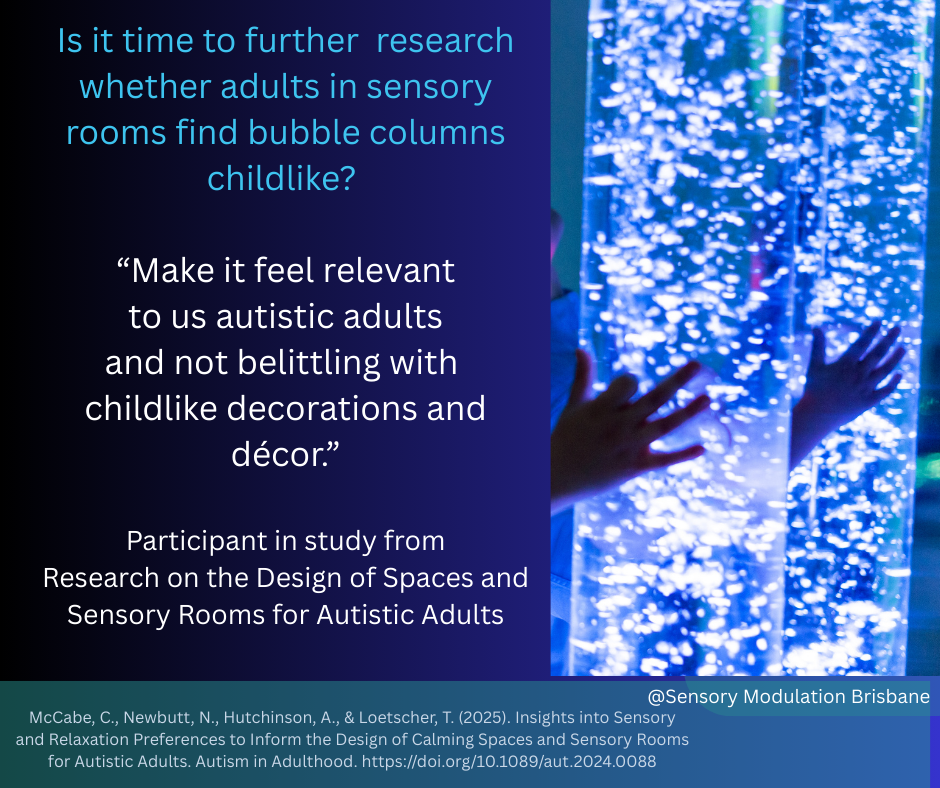
A recent study on the design of sensory spaces for autistic adults shed light on the discomfort some feel when faced with “childlike” décor in spaces that are supposed to offer respite. One participant’s comment stood out: “Make it feel relevant to us autistic adults and not belittling with childlike decorations and décor.” This sentiment points to an issue that has been largely underexplored: Do bubble columns and similar elements unintentionally undermine the autonomy and dignity of adults?
The use of sensory rooms also varies between genders. Studies on psychiatric units have found that females used the sensory room more frequently than males. This pattern has been observed in both adolescent and adult psychiatric populations, where females consistently report higher engagement with sensory interventions compared to males (Novak et al., 2012; McCabe, et al., 2025). While both genders report similar levels of distress reduction following sensory room use, males are often less inclined to engage with these spaces. Novak et al (2012) advised that “Further work is required to ensure that the resources in the sensory room are appropriate for males and that staff are educated about the usefulness of the room for both males and females.” The sensory room features such as bubble columns may be an important resource to research further to identify if it is a factor in some people preferring not to use the sensory rooms.
The Bubble Column: Therapeutic Tool or Overly Infantilising?
Bubble columns have long been used in sensory rooms, primarily due to their calming effect. The slow, mesmerizing rise of bubbles, combined with gentle light displays, can help regulate sensory input, providing a soothing experience for many individuals. These columns are often praised for their ability to offer sensory stimulation in a controlled and predictable manner. However, their design—vibrant, brightly coloured, and somewhat whimsical—tends to evoke a sense of playfulness or even childishness.
For children, this may be fitting. Sensory rooms designed for young individuals frequently incorporate playful, engaging elements meant to spark curiosity and excitement. But when we apply these same designs to environments intended for adults—particularly autistic adults who may already feel marginalized or misunderstood—the question arises: Are we perpetuating a sense of infantilization?
Adults have specific needs and challenges that differ from those of children. They may seek sensory regulation or relief, but the environmental cues that work for them could be vastly different from those that appeal to children. In this context, bubble columns might feel out of place, especially if they evoke memories of childhood experiences or suggest that the space was not truly designed for adult needs.
The Desire for Relevant Design
When the participants in the aforementioned research called for spaces that felt relevant to them as autistic adults, they were asking for an environment that respects their maturity and individuality. We have heard similar comments from other adults that appreciate the sensory rooms for reducing distress and inducing calm but express that some design features do not reflect their adult experiences or needs.
For many individuals, sensory modulation is about finding comfort and relief, not necessarily about engaging with childish décor. Instead of bubble columns, perhaps sensory rooms for adults could be consulted regarding design considerations such as more neutral tones, dimmer lights, minimalistic elements, or even nature-inspired designs that encourage calm without feeling infantilising.
A Call for More Research
Is it time to reconsider the use of bubble columns in sensory rooms for adults? Absolutely. While these columns may offer therapeutic benefits, they should not be the default solution for all sensory spaces. More research is needed to understand the specific preferences of adults when it comes to sensory modulation and room design. This includes exploring whether certain designs, like bubble columns, are seen as infantilising or, conversely, if they truly enhance the sensory experience for adults.
There is also a need for more inclusive design practices that involve autistic adults, sensory room users and adults with mental illness in the conversation about what works for them.
Conclusion
The use of bubble columns in sensory rooms for adults is a topic that warrants deeper consideration. While they are effective for sensory modulation, they need to be designed carefully to meet the needs of adult user. As we continue to develop sensory spaces that are truly inclusive, it's crucial to involve adults in the conversation and ensure that these spaces are designed to meet their unique needs and preferences, free from assumptions or outdated notions of what feels therapeutic.
Ultimately, the goal should be to create sensory rooms that empower and support individuals in a way that feels dignified and relevant to their experiences—not just for children, but for adults too.
References
McCabe, C, Newbutt, N, Hutchinson, A, and Loetscher T. (2025) Insights into Sensory and Relaxation Preferences to Inform the Design of Calming Spaces and Sensory Rooms for Autistic Adults Autism in Adulthood 0 0:0
West, M., Melvin, G., McNamara, F. and Gordon, M. (2017), An evaluation of the use and efficacy of a sensory room within an adolescent psychiatric inpatient unit. Aust Occup Ther J, 64: 253-263. https://doi.org/10.1111/1440-1630.12358
Novak, T., Scanlan, J., McCaul, N., MacDonald, N. & Clarke, T.(2012). Pilot study of a sensory room in an acute psychiatric unit.Australasian Psychiatry, 20, 401–406, doi:10.1177/1039856212459585
Sutton, D., Wilson, M., Van Kessel, K. & Vanderpyl, J. (2013).Optomizing arousal to manage aggression: A pilot study of sen-sory modulation. International Journal of Health Nursing, 22, 500–511, doi:10.1111/inm.12010
Evidence base for sensory modulation in the reduction of restrictive practice for NDIS participants
Evidence base for Sensory Modulation in the reduction of restrictive practices for NDIS participants
We have recorded a presentation and this is available on youtube.
The reference list for this presentation is available here:
Designing a mental health unit with sensory zones
The NSW Government is investing $20 million to help hospital managers improve the therapeutic environment inside acute mental health units – isn’t that great news!
Julie and I have had a lot of conversations over the years about designing our ideal mental health inpatient unit and in this blog we discuss some of the main points.
The NSW Government is investing $20 million to help hospital managers improve the therapeutic environment inside acute mental health units – isn’t that great news!
Julie and I have had a lot of conversations over the years about designing our ideal mental health inpatient unit and in this blog we discuss some of the main points.
Our ideal mental health unit would be able to cater for the people in the unit on many levels. It would be able to cater for mental health needs and some areas would be calming, whilst other areas would be suitable for socialising, creativity or exercise. It would be able to cater for the different sensory needs and some areas would be really quiet and low scent, while other areas would support loud music and strong sensations. People would be able to freely move to the areas that they needed in order to change how they felt through using their senses. This could include to a reading nook or a soothing garden, or a zone with sensory modulation equipment. The design would use trauma informed principles so it would have a homely feel and there wouldn’t be disinfectant smells and fluorescent lights and same curtains everywhere. It would have interesting, helpful and creative activities on the units……. We had so many ideas that we decided to write chapters in our book* on it!
The book has a section on designing or renovating sensational spaces in hospitals, mental health units and aged care facilities. This includes the concept of sensory zones so that people are able to move to the zone that meets their sensory need at the time. In the book there are 19 zones with equipment suggestions and design needs for each of them. 5 of the 19 zones are listed below:
Exercise zone or gym
non slip mats on the floor with vinyl rectangular cushions sectioning off the area so it is not walked over
ideally near a wall. On the wall could be posters with exercises that could assist with anger (e.g. wall pushups, simple yoga and stretches)
equipment including weights, basketball hoops and an exercise ball to sit on or bounce
Low stimulation zone
eye masks
ear plugs, noise-cancelling headphones, music and earphones
wrap or blanket
comfortable, rocking or swinging chair
lower light, light with dimmer switch, low lamp
white noise or soundproofing of zone
nil odour (takes away the scent)
no talking in zone.
Sensory modulation item zone
Sensory modulation items set up for individuals to access
weighted cushions, wraps
blankets, shawls
textured cushions
cardboard boxes to personalise a distress tolerance kit
scented items
icy spray
fidget items
books for sudoku or crosswords
warheads, sour lollies, mints
dencorub, eucalyptus rub.
*Items are assessed and selected with the intention of clients using them independently, without needing a staff member to access or unlock them.
Calm garden zone
garden with variety of plants including variety of leaf shapes and textures
scent to be carefully considered. Would not recommend strong scents in garden zone. Could have a separate zone with scented plants (scent exploration zone)
good to have soothing quality to plants and zone
water feature e.g. pond or waterfall or water sculpture
no hidden or dark zones to assist with soothing (so can let go of hypervigilance).
area for ball games.
Family interaction zone
indoor or (ideally) outdoor area for parents and children
swings or playground equipment that promotes interaction, connection and co-regulation
sandpit or water play
games table
References:
*“Sensory Modulation Resource Manual (2018)” , J O’ Sullivan and C Fitzgibbon.
https://www.barnesandnoble.com/w/sensory-modulation-carolyn-fitzgibbon/1128221915
https://www.pinterest.com.au/SensoryMod/mental-health-unit-design/
https://www.health.nsw.gov.au/patients/mentalhealth/Factsheets/built-therapeutic-environment.pdf
Feedback on the Sensory Modulation Resource Manual from different professional groups
The Sensory Modulation Resource Manual was published earlier in 2018 as an ebook and paperback. We have been getting some feedback from different people and professional groups about what they find useful about the book. We have had feedback from Nurses, Teachers, Occupational Therapists, Parents, Architects, Dentists, Non-Government workers and many others.
Nurses:
Clinical Nurses in Mental Health are finding that the book provides useful resources for using sensory modulation to reduce seclusion and restraint on the inpatient unit. This includes information on designing different spaces or zones within the inpatient unit for different sensory input (sensory spaces), suggestions for equipment for the sensory spaces and a guide to getting starting in using sensory modulation with a client. In June 2018, the NSW government allocated $20 million to improve therapeutic environments within mental health units. The Sensory Modulation Resource Manual is a useful resource for this project.
Teachers:
Teachers are reporting that the Sensory Modulation Resource Manual is useful in understanding the individual sensory preferences of the children in the classrooms and tailoring strategies to the individuals. The section on calming strategies has been popular, in particular using the playground for calming. High school teachers and Guidance Officers have liked the lists of strategies to improve focus, and decrease anxiety.
The Sensory Modulation Resource Manual was published earlier in 2018 as an ebook and paperback. We have been getting some feedback from different people and professional groups about what they find useful about the book. We have had feedback from Nurses, Teachers, Occupational Therapists, Parents, Architects, Dentists, Non-Government workers and many others.
Nurses:
Clinical Nurses in Mental Health are finding that the book provides useful resources for using sensory modulation to reduce seclusion and restraint in the inpatient unit. This includes information on designing different spaces or zones within the inpatient unit for different sensory input (sensory spaces), suggestions for equipment for the sensory spaces and a guide to getting starting in using sensory modulation with a client. In June 2018, the NSW government allocated $20 million to improve therapeutic environments within mental health units. The Sensory Modulation Resource Manual is a useful resource for this project.
Teachers:
Teachers are reporting that the Sensory Modulation Resource Manual is useful in understanding the individual sensory preferences of the children in the classrooms and tailoring strategies to the individuals. The section on calming strategies has been popular, in particular using the playground for calming. High school teachers and Guidance Officers have liked the lists of strategies to improve focus, and decrease anxiety.
Occupational Therapists:
Mental Health OTs are benefitting from the resource section of the book eg handouts on sensory modulation, sensory kits, self soothing and strategies for anger and agitation. New graduate and student OTs are reporting that the section on getting started with using Sensory Modulation as an intervention is very useful. Student OTs are the ones who are purchasing the ebook in the greatest numbers (this is the cheapest option) however other OTs are preferring the paperback version.
There are increasing numbers of OTs in the physical and paediatric areas who are finding Sensory Modulation is able to be applied to their area of practice.
Parents:
Parents of adolescents have been interested in the section on alternatives to self harm, developing sensory kits, substance use and understanding sensory seeking in adolescents. A number of parents are finding that their children are using weighted items and cold water to calm down.
Architects
Architects have been positive about the information on understanding sensory processing and the chapter on Sensational Spaces, and the impact that the environment has on changing how people are feeling.
Allied Health/Health Practitioners/Support Workers
The Sensory Modulation Resource Manual has been of interest to a wide range of people who work in the health field. This has included chiropractors, ophthalmologists, dieticians and dentists. Interest areas have included the information on the senses and sensory preferences, and strategies to assist the particular individuals that they are working with.
Sensory Modulation Resource Manual
E-book: available on Amazon
Paperback: available at bookstores including Barnes and Noble, Avid Reader, Book Depository, Amazon.
Reviews on Amazon:
"A fantastic resource and contribution to the field of sensory modulation and occupational therapy in mental health."
"Excellent practical book which brings together the neuroscience and strategies that work in practice!!"
"This is an excellent resource for all teachers, counsellors and those in school leadership. It will open our eyes to adapting our enviornments to suit the diverse needs of learners."
Having a heavy dog sit on your lap can be calming!
Water can cool down a temper in the playground
Designing a sensory space - lots of ideas in the book